Saturday, 26 June 2021

CHANGE TO USE OF THIS BLOG PAGE

As of today, 26th June, 2021, this page will be dedicated to giving update information on group organisation and activities

Information on latest wildlife sightings can now be seen and recorded on the Blackfordby Wildlife Group's WhatsApp channel. To join this group, please contact Richard Pegler via blackfordbywg@btinternet.com

Monday, 3 May 2021

April Birds and Flowers

Greetings all. 

Brian has kindly sent me some photos of birds and flowers, all taken in Melbourne (Derbyshire) during three weeks in April.  I am particularly envious of his sighting (and photo!) of the Red-crested Pochard!

Red-crested Pochard (Netta rufina) (male)

Great Crested Grebe (Podiceps cristatus)

Coot (Fulica atra)

Greylag Goose (Anser anser)

Pied Wagtail (Motacilla alba yarrellii) (male)

Tufted Duck (Aythya fuligula) (male)

Mallard (Anas platyrhynchos) (female with chicks)

Ground-ivy (Gledchoma hederacea)

Opposite-leaved Golden Saxifrage (Chrysosplenium oppositifolium)

Butterburr (Petasites hybridus)


probable Water Cress (Rorippa nasturtium-aquaticum)
Thank you, Brian

Please, everyone, do respond to Brian's email about a proposal for the group having a presence on social media - either WhatsApp or Facebook.

This would enable group members to immediately post information on their sightings or other wildlife related news, and give the rest of the group members immediate notification and access to such information. For example, Joe Bloggs could post "I'm watching a Ring-necked Parrot feeding on cherries near the entrance to Sarah's Wood - I will be here for an hour if you want it pointed out to you".

This would be a 'closed group' only visible to group members,

Take care, everyone. I'm hoping that we can get together before the summer is over!


Sunday, 11 April 2021

Food For Hedgehogs (and Birds)

Greetings, Folks!

Most of you will, I hope, be aware that it is unhealthy for Hedgehogs to have access to more than a few mealworms. Hedgehogs love them, but mealworms are low in calcium and so the hogs can end up with crippling bone disease causing their bones to break easily. Through a discussion on t'interweb, I learned fairly recently that mealworms can have a similar effect on birds too!

This caused me to look around. One lady said she coated her mealworms in calcium powder, but this looked a bit hazardous to me. I was then pointed at dried 'Calciworms' by a friend. Calciworms is an informal term for what are strictly known as Black Soldier Fly (BSF) larvae. These are high in calcium and considered safe for Hedgehogs and birds. 

I have tried deploying these, and the Hedgehogs took to them immediately. I have to be careful about when I put them out as they are also a hit with the birds. Too early and they are all gone by the time that the hogs get there!

I bought mine on-line from an outfit called Chubby Mealworms and have been delighted with their service and product. They are, however, available from a number of other sources.

I place a small dish of BSF larvae where the hogs have to work to get their fill. They found them on the first night! I finish this blog post with a video clip of one of the hogs (I think we have four visiting regularly at the moment) going on a mountaineering trip for his supper! Note that when he'd finished eating he went straight for a drink - it is important to have fresh water nearby.

Having water nearby is important for the birds also. They too go for a drink after eating them and, in fact, the Magpies take the larvae from the dish and dunk them in the water before eating them!

That's all for now. Please let me have any news and photos you might want to share with the rest of the group.

Best wishes to all. Take good care - - - Richard
 

Sunday, 4 April 2021

Mouse Party

Greetings once more, Folks

Colin Carr has sent in a couple of photos and an explanation as follows:- 

Here's an unusual one you might like.

We discovered that a lovely heirloom made by Jen's dad years ago - a homemade dolls house - has been invaded ..... by mice.

Despite being stored four foot off the ground in the garage, mice had found their way in and decided to make themselves at home, not like the others slumming it in
holes outside.

They moved the furniture, stripped the wallpaper and thoroughly trashed the place!

Talk about a Mouse Party!

At least we have photographic evidence for the mouse police.

At first we were horrified but in the end you have to see the funny side.

CC


Fabulous! Thank you, Colin for delightfully entertaining us, although I'm sorry that a family heirloom has been trashed.
 
Take good care folks - it's not over yet!
 

Tuesday, 30 March 2021

Robin in Song - on 28th March, 2021

Greetings, Folks!

Brian has kindly sent in a photo of a Robin that posed nicely for him on Sunday morning as he sang heartily on his view point. I assume that Brian meant it was the Robin that was singing and not himself!

Thank you, Brian.

Make the most of this good weather if you can - I understand that it's going to get rather cold again by the weekend!

Stay safe - - - Richard
 

Monday, 8 March 2021

Spring Is Sprung!

Hot on the heels of his last contribution, Brian sent in some photos a week ago taken on one of his local walks. I hope that you will forgive me, Brian, for not publishing these until now, but with so little coming in at the moment I thought that I should spread it out a bit. However, I'm now beginning to wonder if this is the right approach?

Brian's photos were all taken on 1st March on Heath Lane.

Thank you, Brian!

Primroses - Heath Lane

Hazel - Heath Lane

Snowdrops - Heath Lane

Does anyone remember a poem that went something like this, from way back in my youth? - sounds as if it might have been something from Spike Milligan :-

  Spring is sprung

  The grass is riz

  I wonder where dem boidies is

  De boid is on the wing

  But dat's absoid

  I tought de wing was on de boid


Until the next time. Take great care everyone - - - Richard


Sunday, 28 February 2021

A Few Gulls!

Greetings, Folks!

Brian has sent in a couple of photos with the following note:-

Where do all the gulls suddenly arrive from when the farmer starts ploughing? We normally only see a handful in the field behind us but there were hundreds the other day as soon as the ploughing started they arrived.


Did you count them, Brian? I'm sure the County Recorder would like details of species and numbers!  ;-}

I wouldn't be at all surprised if these had come from the Gull Roost that is relatively close by at Albert Village.

Thank you, Brian, for these, which brought a smile to my face!


If any group members have any interesting wildlife information and/or photos to offer for the blog, I'd be delighted to receive them.


A quick note about Hedgehogs

It seems that Hedgehogs are emerging early this year. We have had sightings every night this week, with at least three on one one night and at least two a couple of nights later. You might like to consider putting food and water out for them if you think that you have Heedgehogs near you. We feed ours on Tesco Chicken Kitten dried food, which is favoured by  some professionals.


Hoping that we will all be able to meet up again soon. In the meantime, take good care and stay safe.

Richard


Monday, 1 February 2021

Colin's Garden Mustelid

I have received a message from Colin Carr with some photos - as follows:-

When you look out of the early morning window for some signs of Spring, and see something else entirely! #stoat or #weasel

Hard to be sure when you can't see the tail.   I would guess at the former based purely on its small but highly alert stature.

Sorry for the poor photography, but they move in spurts so very fast.

Only the second I have seen in the garden since moving to Blackfordby 5+ years ago.


Stoat (Mustela erminea) or Weasel (Mustela nivalis) - Colin Carr's garden in January, 2021
It can be difficult to see the difference between a Stoat and a Weasel but, as Colin mentions, the real clue is in the tail. A Stoat has a black tip to a tail that is approximately half the length of the body. The Weasel's tail is purely brown and rather short in comparison. A Stoat has a body length of 30-34cm, whereas the smaller Weasel is 20-27 cm. If that's a 4 inch pipe in Colin's second photo, it suggests to me that the animal has a body length of around 8 inches (20cm), challenging Colin's conclusion that it is probably a Stoat. Brian and I think that it is probably a Weasel. 
Note: due to me initially miss-reading an ID guide, I have changed the above paragraph! RP
 
There is an old addage that simplifies the situation:- "A Weasel is weasily recognised, but a Stoat is stotally different"!

Thank you, Colin, for sending in these delightful photos to brighten our day!

I hope that you are all managing to stay safe and well and that we'll have the opportunity to meet up in the not too distant future.

Best wishes - Richard


Sunday, 17 January 2021

Lockdown Winter - from Brian

While the threat of this terrible virus still has us in its grip, most of us are, I believe, pretty-much confined to our homes, and our wildlife observations will largely be of what we can see from the windows of our houses. 

Brian has kindly sent me some photos of winter sightings which beautifully capture the spirit of winter.

The first is of a Magpie sitting in what I think might be a Viburnum (we have a similar tree in flower still, which is a Viburnum) 

Snowy Vigil
The winter theme continues, with his shot of a SilverBirch covered in hoar frost.
 
Hoar Frost on Silver Birch
His last shot is not so wintery, but is, nevertheless, seasonal and depicts a Long-tailed Tit. These small birds are often in need of our help in winter.

Long-tailed Tit
Thank you, Brian for these delightful images!

A sustained cold spell is often extremely difficult for birds, and supplemental feeding in our gardens can be of great benefit to them. However, every bit as important to them is a supply of fresh water. This should be changed on a regular basis.

Even more important is to regularly check that the water has not frozen. We use plant-pot dishes for some of our supply for the birds. When these freeze, they can be tipped up-side-down,  the ice knocked out in one piece, and then refilled with water. For our immovable 'bird baths' I take a kettle of boiling water to them, ensuring that the water is cold before I leave it.

Having Pied Wagtail in our garden is extremely rare - most years we don't see one - but during the recent freeze we were visited by one several times a day and I am sure that this is because we had the only non-frozen water in the area. As soon as the freeze was gone, the wagtail disappeared!

Pied Wagtail - the Pegler garden on 7th January 2021

Hopefully, the Covid vaccination programme will continue apace and we will all be able to meet up again in the not-too-distant future.

In the meantime, take great care and stay safe.

Richard Pegler
 

Thursday, 17 December 2020

Winter Thrushes

At this time of year, we are visited by thrushes from the continent. These are, mainly, Fieldfare and Redwing. The Redwing is a small thrush, with a distinctive stripe on its head and a red patch under the wing. The Fieldfare is a larger thrush with a speckled breast and grey head. Both tend to travel in small noisy flocks. This year it seems that numbers are less than usual, but this may change if harsher weather arrives. Have you seen one yet?

Their main source of food is berries in hedgerows but, especially in severe weather or when berries run short, they can be tempted into gardens. They are quite partial to half an apple left face-up on the ground or stuck on the end of a branch or a stick in the ground. 

Fieldfare (Turdus pilaris) - Pastures Lane, Oakthorpe
Redwing (Turdus iliacus) - Oakthorpe Colliery
Wishing all a very happy Christmas, and a much-improved 2021!

Take good care

Richard

Friday, 4 December 2020

Birds from Brian

Greetings, all! I hope you are all well, and staying safe.

The weather has been more than a little grim of late, so here are a couple photos from Brian, taken of birds in his garden, to brighten your day! Thank you Brian.

I am using Brian's captions as I don't think anyone will have difficulty in identifying the species!!!

Sentry Duty on a misty morning

Another Sentry
Hang on in there - there's a light showing at the end of the tunnel. Best wishes - - - Richard


Friday, 20 November 2020

Goat Moth

Group member Sallie Corfield has sent in an exciting bit of news about a moth sighting she reported to the County Moth Recorder. Sallie, in her capacity as Community Ranger for Forestry England, was working on Forestry England's stand at the Timber festival in Feanedock Wood in July, 2019. County Moth Recorder for Leicestershire & Rutland, Adrian Russell had a 'walk-in' moth trap (something I'd love to see in action!) set up there, and Sallie wandered in and spotted and photographed a hitherto undetected moth, which she reported to Adrian. It was a Goat Moth! This once-common moth has become extremely rare, and the previous record in VC55 (Leics & Rutland) was in 1990 at Brown's Hill Quarry, near Melton Mowbray.

Adrian suggested to Sallie that it might be worthwhile surveying the area for signs of the Goat Moth, and I agree with Sallie's suggestion that we should make the groups members aware of this in case they would like to involve themselves in such an activity. Although the moth flies in June and July, its presence can be detected by the holes bored in trees by the caterpillars. If you would like to know more about the Goat Moth, which is one of UK's largest moths, and how to find them, please look at https://butterfly-conservation.org/sites/default/files/1.goat-moth-species-factsheet.pdf. If you would like to discuss this with me (Richard Pegler), please get in touch. In current circumstances, visits will have to be on an individual basis but, in happier times ( fingers are crossed) a small group visit might be arranged. I visited Feanedock Wood yesterday, and it is a splendid place. It is within walking distance of Blackfordby and can be found on the right hand side of Gorse Lane bridleway (as accessed from Boothorpe) through a gate before you descend the hill to Rawdon Road and Conkers.

Goat Moth (Cossus cossus) - Feanedock Wood

Incidentally, I didn't find any hard evidence during my visit yesterday, but did see a couple of tree trunks that had me wondering!?

Thank you, Sallie for this, and congratulations on this fabulous find!

Take great care and stay safe, everyone - - - Richard
 

Friday, 13 November 2020

Cue For a Song?!

Brian has sent in a wonderful image, with the following note:-

Attached is a picture a friend in Montrose, Scotland, sent me of Pink-footed Geese flying in front of a rainbow. My friend's name is Andy Wakelin. Montrose has an inland sea called Montrose Basin which has a Wildlife Centre. It is famous for it's flocks of geese every Autumn. This year there were over 84,000 at the basin. It is a great place to visit if any members are ever on the East Coast of Scotland see web site https://scottishwildlifetrust.org.uk/reserve/montrose-basin/

Pink-footed Goose (Anser brachyrhynchus) - Montrose Basin, Scotland

Thank you, Andy and Brian - much appreciated! 


Saturday, 7 November 2020

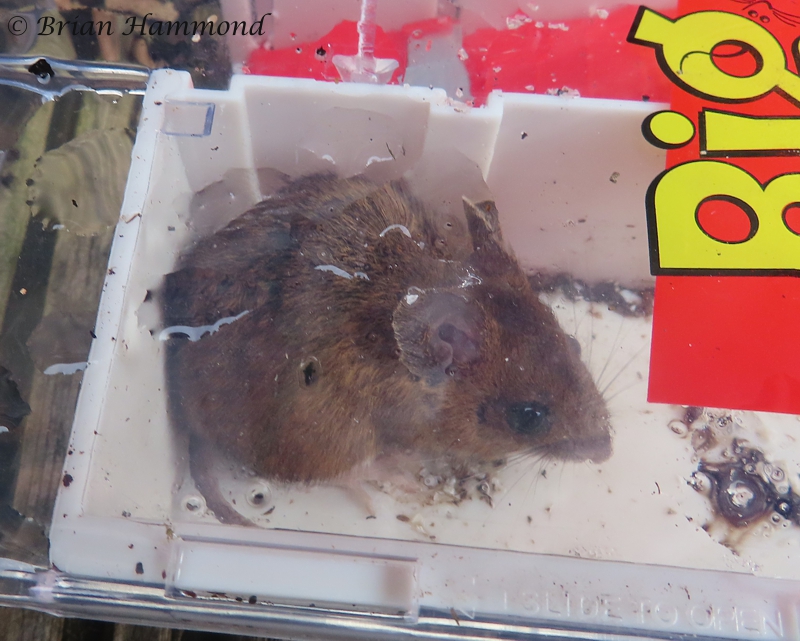
Mouse Problem - Solved!

Our Chaiman, Brian, has had a mouse problem. I'll let Brian take over with the description, extracted from his emails to me. If you have a mouse problem you might find the following useful :-


I have a lot of problems with House mice in the shed that we store bird & dog food in, they even chew through plastic storage boxes if given the chance. I hate using lethal traps so bought a humane trap to try. I had tried a different design last year that wasn't very successful, however the new one has been out only 3 days & has already caught 2 mice so seems quite good. I am fairly sure they are House Mice (Mus musculus) but not certain. This one got a bath when I released it in the field away from the house as it jumped straight out of the trap into a puddle, shook itself and hopped off at a great pace. You need to clean & dry the trap between baiting it or the seesaw trap door sticks. They then eat the bait and can escape, cleaning & drying it stops that happening. Best bait is crunchy peanut butter.

The trap came from Ivanhoe Country Store & was less than £8. It works on a seesaw principle the weight of the mouse tips the seesaw & this raises the weighted door on the other end stopping the mouse from getting out again - (most of the time). The previous type I tried was much smaller & the whole trap was supposed to tip & a door shut but I never got it to catch anything so I threw it away. I always use Peanut butter as a bait as they love it, I also bait not only inside the trap but also on the inward end of the seesaw 


Thank you for this interesting information, Brian. I hope that the trap is continuing to serve you well

Saturday, 31 October 2020

The Marmite Bird!

There are, I know, mixed feelings out there about visits to the garden by Sparrowhawks and taking the birds that we are attracting to the garden bird feeders. My wife is very much set against them and, although she wishes no harm to the Sparrowhawks, she insists on banging on the window or waving her arms to discourage them. I, however, am pleased to see them, and regard them as magnificent creatures and an indicator of the state of the environment  - although I'd prefer it if they'd not take some of our less common birds!

The male Sparrowhawk, with its orange tinged frontage, is somewhat smaller than the female, and confines its prey to the smaller species of bird.

Sparrowhawk (Accipiter nisus) (male) - our Ashby garden on 9th October, 2020
The larger female of the species, which has the orange replaced by brown on the frontage, will take larger birds, such as Collared Doves, as prey. The one below is, I believe, a young female, having pale edges to the wing coverts and yellow, rather than orange, eyes.
Sparrowhawk (Accipiter nisus) (female) - our Ashby garden on 23rd October, 2020
I would be interested to hear whether you see Sparrowhawks in your garden, and what your attitude towards them is!

Until the next time - take good care and stay safe - - - Richard Pegler

Saturday, 24 October 2020

Shieldbugs

I'm no expert, but I have a passing interest in shieldbugs, sometimes referred to as 'stinkbugs' with good reason!

There are, I believe, 32 species of shieldbug to be found in UK if you exclude the Coreidae (which includes the common Dock Bug). Of these, I think that 23 species have been recorded inVC55 (Leicestershire and Rutland vice-county).

An excellent guide to shieldbug identification can be found here:-  https://www.britishbugs.org.uk/heteroptera/idcards/life_stages.html

There are still some to be found at this time as I write this and this is one I found recently sitting on top of my garden waste recycling bin.

Birch Shieldbug (Elasmostethus interstinctus) (adult) - our Ashby garden on 22nd October, 2020

If you have any information or photos of local wildlife interest, please contact me at blackfordbywg@btinternet.com

Best wishes to all - - - Richard Pegler
 

Monday, 19 October 2020

A Caterpillar and Some Fungi

Our Chairman, Brian, has recently had a short break in Suffolk, where he visited Sutton Hoo, and also took some photos of a caterpillar and some fungi. Brian asked if I thought it appropriate to put up non-local material, and I certainly do in this case as it has relevance to the local area too as it is a good time for fungi. However, I know virutally nothing about fungi, other than that the Parasol Mushroom is said to be excellent eating - provided you are confident in your identification!


Parasol Mushroom (Macrolepiota procera) - Sutton Hoo

Shaggy Inkcap (Coprinus comatus) - Sutton Hoo
The Fox Moth caterpillar is a fully-fed individual, which will bide its time without further feeding and pupate in the spring.

Fox Moth (Macrothylacia rubi) (larva) - Sutton Hoo

Thank you, Brian for these, which are much-appreciated. 

Please, folks, don't hesitate to send in your photos and observations. In the meantime, take great care and stay safe - - - Richard Pegler


Saturday, 10 October 2020

Toadlet Rescue!

Our Chairman, Brian, found this baby toadlet in his dog's drinking bowl. It had managed to get itself in, but couldn't get out again as the sides of the bowl were too slippery. Brian rescued it and it hopped away again. Well done Brian - see you in the honours list for services to young toads! 


Monday, 24 August 2020

Brian's Hedgehog - and other night visitors!

Hi Folks. I know some of you will have seen this already, but our Chairman, Brian, put out some food for the Hedgehogs recently. He had three visits by a Hedgehog that night, but also two cats got in on the act. 


Cats are a tad more cunning than hedgehogs, and there's a danger that they will spread the word and you'll soon find that  you are being eaten out of house and home by the felines, and the poor hedgehogs won't get a look-in. 

I guard against this with home-made hedgehog feeding stations, made out of an upturned clear under-bed storage box (cheap in Wilko's), with a 13 cm x 13 cm hole with a rounded top cut in one end. The lid then forms the base of the feeder, and can be lined with newspaper. I also make a tunnel entrance from two house bricks on their sides with a roof tile on top, weighed down with a rock. With adjustment, cats can't get in. I leave Tesco's kitten biscuits (recommended by the Leicester Hedgehog Rescue people) in a raised mesh tray of the type used for bird seed. I also leave a dish of water outside the feeding station - I use the flat plastic dishes of the type that you stand plant pots in, but use chicken 'drinkers' if I'm going to be away for an extended period. 


Take good care and stay safe - - - Richard

Tuesday, 11 August 2020

Sallie's Dragon - August, 2020

Group member Sallie Corfield has sent in some super photos with the following message:-

"Thought I’d send these photos on of a southern hawker (unless I’m wrong in my ID?) ovipositing in my pond. It must have been doing this for around 45 minutes and mostly in the same place in the moss on this log next to the water. My kids were absolutely captivated! My pond is quite new having been put in around a year ago. "

What a wonderful experience, Sallie! Nothing wrong with your ID - a female Southern Hawker is probably the most likely dragonfly to visit a garden pond in these parts in order to lay eggs, and they do like a patch of moss to lay into too!

I hope that, if you have a garden without a garden pond, this will help to encourage you to put one in. You might be amazed and entertained by what visits.

Southern Hawker (Aeshna cyanea) (female) - Sallie's garden

Thank you so much for sending in these photos and information, Sallie - very much appreciated! 

Take good care, folks, and stay safe - it's not over yet!