Thursday, 18 June 2020

ORCHIDS OF NORTH WEST LEICESTERSHIRE

Our Chairman, Brian Hammond, has kindly supplied some photos and words about some of the fabulous orchids that he has found recently. I'll let Brian describe these in his own words.


ORCHIDS OF NORTH WEST LEICESTERSHIRE

All photos were taken in the last 2 weeks and all are within 15 miles of Blackfordby. 

Lizard Orchid - Himantoglossum hircinum - Very rare this far North, only specimens in Leicestershire. Normally a plant of Kent & the South Coast.

Lizard Orchid (Himantoglossum hircinum)

Bee Orchid - Ophrys apifera - Quite a few arroud this year in different locations.
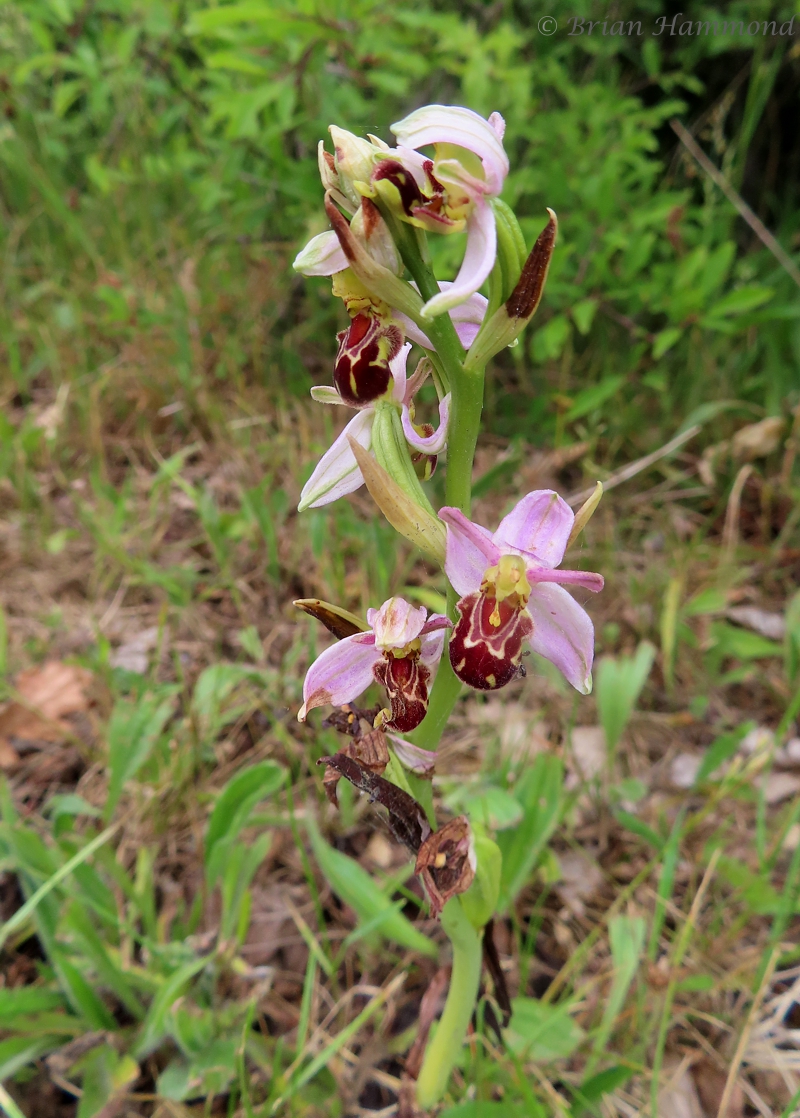
Bee Orchid (Ophrys apifera)

Greater Butterfly Orchid - Platanthera chlorantha - A beautiful but uncommon British Orchid.


Greater Butterfly Orchid (Platanthera chlorantha)

Common Spotted Orchid - Dactylorhiza fuchsii -This is the most common local Orchid.

Common Spotted Orchid (Dactylorhiza fuchsii)

Violet Helleborine - Epipactis purpurata - Uncommon Orchid that grows in a few dark woodland. Flowers in mid to late July so this specimen is just coming up ready to flower in a few weeks. The violet colour that gives it it's name is clearly visible in the picture.

Violet Helleborine (Epipactis purpurata)

Thank you, Brian, for these great photos and interesting information.

Take good care folks, and stay safe. 


Wednesday, 10 June 2020

Birds, a Bee, and a Bold Squirrel

I've received some delightful photos submitted by Brian and Simon. I confess to examining Simon's beautiful shots rather closely to check if that tree that both the shots featured was artificial or Photoshopped, as there did not seem to be a hair out of place between the two. It's real, folks!

Robin (Erithacus rubecula) - Simon's garden
Goldfinch (Carduelis carduelis) - Simon's garden
Here are Brian's birds:-

Blue Tit (Cyanistes caeruleus) - Brian's garden
Magpie (Pica pica) - Brian's garden
Starling  (Sturnus vulgaris) (juvenile) - Brian's garden
Rook (Corvus frugilegus) - Brian's garden
Brian has nicely documented a Grey Squirrel raiding his bird feeder. There are mixed feelings about squirrels out there, but I'm rather fond of them, and it's not their fault that somebody brought them here from America!


Grey Squirrel (Sciurus carolinensis) - Brian's garden
Brian also sent in a photo of a bee, asking if I could ID it. Sadly, I'm not knowledgeable about bees but, by consulting on the excellent Naturespot web site, I have come to the conclusion that it's Early Bumblebee - please let me know if you think I've got it wrong!

Early Bumblebee (Bombus pratorum) - Brian's garden
That's all for now folks. Until the next time, take good care and stay safe - - - Richard


Thursday, 4 June 2020

Colin's Wildflower Meadow - and a new book on local walks

Greetings, folks! 

In 2018, Colin Carr, with the aid of our chairman Brian, seeded part of his paddock with wildflowers. The results are nothing short of wonderful, as you can see from the delightful photos that Colin has submitted. 

Colin's wildflower patch - Blackfordby
 Here are some of the beautiful wildflowers it contains.

Yellow Rattle (Rhinanthus minor) - Colin's Wildflower Meadow
Meadow Cranesbill (Geranium pratense) (white form) - Colin's Wildflower Meadow
Oxeye Daisy (Leucanthemum vulgare) - Colin's Wildflower Meadow
Viper's Bugloss (Echium vulgare) - Colin's Wildflower Meadow
I suspect that everyone knows by now that bees, and many other invertebrates, are perilously declining in numbers, largely due to farming methods and also through loss of habitat to human occupation. I have heard it said, on many an occasion, that if bees disappear the human race will soon follow. It is my belief that we should all be looking for ways to provide places for insects to thrive - whether we have a large plot of land, like Colin, or just a 'postage stamp' sized garden, or even just the ability to have a window box.

Many people are trying to persuade local councils to stop mowing verges and allow wildflowers to re-take posession - unless there's a safety issue - thereby doing something towards saving the planet, and money too! 

Next time you get frustrated by persistent Dandelions, please remember that they're great for wildlife. Take joy from a verge filled with Dandelions - or even Dandelions in your lawn. In fact, consider the possibilities of converting your lawn into a relatively maintenance-free flower meadow.


Colin also sent in a photo of a Squirrel dray at the edge of his meadow.  I'm not about to get into the pros and cons of Grey Squirrels here!

Squirrel dray - Colin's Paddock
Colin also kindly notified Brian and I of a short 'e-book' produced by local walker, Mark White, covering local walks in West Ashby. Mark has kindly given permission for me to publicise it here. If you are interested, it's available free-of-charge in .pdf format by emailing Mark at walkingwestashby@gmail.com

 
Take great care, and stay safe. We'll meet again someday - unlike Vera Lynn, I suspect I know where - I just don't know when!

Sunday, 24 May 2020

Frog Ramp!

Greetings, everyone! I hope that you are all well and have been managing to enjoy local wildlife.

Colin Carr has kindly sent in some photos of a project that should be of benefit to some of the wildlife that visits his garden pond. I'll let Colin take up the story.


"The stuff you get up to in lockdown. Had the idea for a frog ramp so the new ones can get out of the pond.

Blackfordby's super wood worker Stephen Sinfield  kindly put together one for us. But even before we could see if it worked a frog decided to take a dip first.  

The last image (taken two days later) shows it is already a huge success with the tadpoles which appreciate the shallow water it provides."


My Thanks to Colin for the above.

Garden ponds are of great benefit to wildlife, and the well-known Butterfly Brothers have recently stated that, if asked to nominate the most important feature required to make a garden wildlife-friendly, thay always reply - a garden pond.

My wife has a frog phobia so our 2 metre deep koi pond got filled in about 15 years ago and we've not had a pond since, in spite of my hankering to have a wildlife pond, as it would encourage frogs.

I hope, however, that we have now found a solution. For my birthday next month, I expect a delivery of a kit to make a free-standing pond with half-metre high walls with an overhanging lip. This will, hopefully, then be frog-free in deference to Mrs P's fears, but will attract other wildlife - I'm hoping for dragons and damsels! As with Colin's pond, and as recommended by the Butterfly Brothers, this will have a ramp to enable anything falling into the pond to climb out. I'll probably report on progress in due course.

In the meantime, take great care and stay safe - and look after the wildlife out there.

Richard Pegler

Thursday, 21 May 2020

Some Moths from Colin, Sallie, and Brian

Group members Colin Carr and Sallie Corfield, and our chairman Brian Hammond have sent in some photos of moths that they've caught in the moth traps, or in his conservatory in Colin's case!

Here's Colin's rather beautiful moth:-

Small Magpie (Eurryhypara hortulata) - Blackfordby
 Here are Sallie's - I'm very envious of the Poplar Hawk-moth, Sallie, as I've never caught one!

Flame Shoulder (Ochropleura plecta) - Blackfordby
Garden Carpet (Xanthorhoe fluctuata) - Blackfordby
Muslin Moth (Diaphora mendica) (male) - Blackfordby
Shuttle-shaped Dart (Agrotis puta) - Blackfordby
Poplar Hawk-moth (Laothoe populi) - Blackfordby
Here are Brian's moths:-

Angle Shades (Phlogophora meticulosa) - Blackfordby
Bright-line Brown-eye (Lacanobia oleracea) - Blackfordby
Common Swift (Hepialus lupulinus) (male) - Blackfordby
Gold Spot (Plusia festucae) - Blackfordby
I finish this off with a fly, rather than a moth, from Brian. This fly looks more ferocious than it is! 


St Marks Fly (Bibio marci) - Blackfordby
Thank you, Colin, Sallie, and Brian for your much-appreciated contributions.

I hope that everyone is staying safe and well. I think that the next blog post will feature some work that Colin Carr has been doing with the aid of Stephen Sinfield!

Tuesday, 12 May 2020

Some Photos From Brian and Min

Firstly, my apologies for not posting on the blog for a while - I have been a bit busy and otherwise preoccupied. These photos were received a few days ago from our Chairman, Brian Hammond, and from group member Min Bell. My thanks for your much-appreciated contributions.

Here are Brian's photos, which are of shieldbugs. Brian also noted:- "Lot's of Green Shieldbugs (Palomena prasina) around at the moment. Haven't got a good picture from this year yet but here is one from 2019. Woundwort shieldbug (Eysarcoris venustissimusis) is tiny only 4-5mm. A very pretty small bug with a long name it was a devil to photograph as it wouldn't stay still. It also feeds on White Deadnettle & there is lots of that around Blackfordby at the moment."

Common Green Shieldbug (Palomena prasina) (adult) - Blackfordby

Woundwort Shieldbug  (Eysarcoris venustissimusis) (adult) - Blackfordby
I have noted these as being 'adult' as shieldbugs, like many other beetles, bugs, etc. have several 'instars' before achieving adulthood, with the instars looking somewhat different to adults. You can find an excellent ID guide to shieldbugs here:-  https://www.britishbugs.org.uk/heteroptera/idcards/life_stages.html.

Min's contribution also came with a brief note:- "I don't have a good enough camera for garden birds. These starlings are very cheeky! And the blackbirds are nesting next door. The footballer was also obliging." - Sorry, Min, but I have to disagree with you about the standard of your camera - these photos are delightful!

"Starling queuing for grub" - Starling (Sturnus vulgaris) - Blackfordby
"Hen Blackbird also waiting" - Blackbird (Turdus merula) (female) - Blackfordby
Min also photographed this hoverfly which has a very apt common name!

The Footballer (Helophilus hybridus) - Blackfordby
That's all for this post. I have some more of Brian's photos waiting for a future blog post.

In the meantime, take great care and stay safe - - - Richard

Monday, 4 May 2020

April Wildflowers - From Brian

Our Chairman, Brian,  has been photographing wildflowers again, in his garden and in some nearby locations.

This first one is an introduced species.

White Spanish Bluebell (Hyacinthoides hispanica) - Blackfordby
This next one also is not a native wildflower, but a garden escape.

Honesty (Lunaria annua) - Blackfordby
Variegated Yellow Archangel is a British native but the plants in Blackfordby are probably garden escapes as they are regularly grown in gardens.

Variegated Yellow Archangel (Lamiastrum (Galeobdolon) luteum) - Blackfordby
Cow Parsley (Anthriscus sylvestris) - Blackfordby
Germander Speedwell (Veronica chamaedrys) - Blackfordby
Herb Robert (Geranium robertianum) - Blackfordby
Wild Strawberry (Fragaria vesca) - Blackfordby
Bluebell (Hyacinthoides non-scripta) - Blackfordby
May blossom (Crataegus monogyna) - Blackfordby
Red Campion (Silene dioica) - Blackfordby
Meadow Buttercup (Ranunculus acris) - Blackfordby
Creeping Buttercup (Ranunculus repens) - Blackfordby
Groundsel - (Senecio vulgaris) - Blackfordby
Field Pansy (Viola arvensis) (pale form) - Blackfordby
Dandelion (Taraxacum officinale agg.) - Blackfordby
The 'agg.' bit in the scientific name given above for the Dandelion is an indication that it has not been possible to tie the identification down to a fully specific level. Brian notes that "there are 210 different sub-species that are almost impossible to separate".

Thank you, Brian, for these photos with ID information.

I'm not sure, at this stage, what the next blog post will feature. In the meantime, stay safe, stay well, and stay at home! 

Richard