Saturday, 7 November 2020

Mouse Problem - Solved!

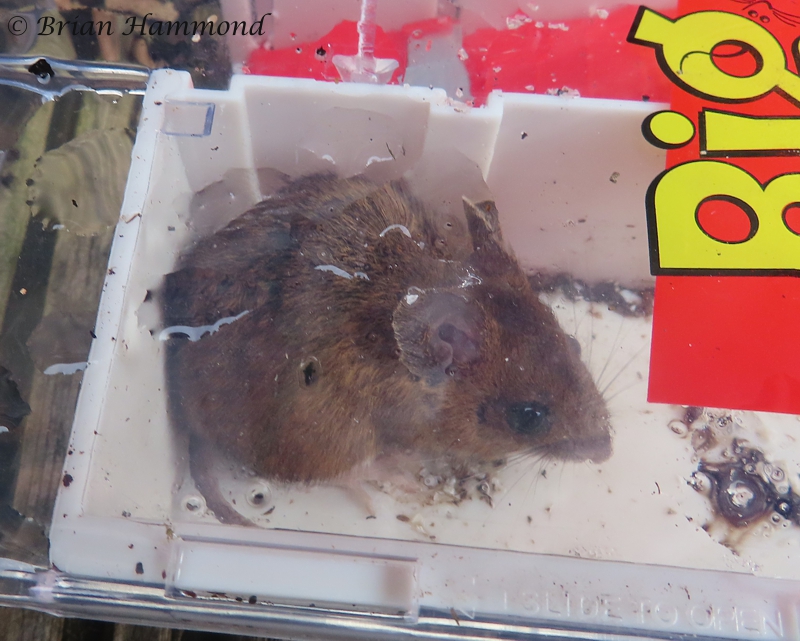
Our Chaiman, Brian, has had a mouse problem. I'll let Brian take over with the description, extracted from his emails to me. If you have a mouse problem you might find the following useful :-


I have a lot of problems with House mice in the shed that we store bird & dog food in, they even chew through plastic storage boxes if given the chance. I hate using lethal traps so bought a humane trap to try. I had tried a different design last year that wasn't very successful, however the new one has been out only 3 days & has already caught 2 mice so seems quite good. I am fairly sure they are House Mice (Mus musculus) but not certain. This one got a bath when I released it in the field away from the house as it jumped straight out of the trap into a puddle, shook itself and hopped off at a great pace. You need to clean & dry the trap between baiting it or the seesaw trap door sticks. They then eat the bait and can escape, cleaning & drying it stops that happening. Best bait is crunchy peanut butter.

The trap came from Ivanhoe Country Store & was less than £8. It works on a seesaw principle the weight of the mouse tips the seesaw & this raises the weighted door on the other end stopping the mouse from getting out again - (most of the time). The previous type I tried was much smaller & the whole trap was supposed to tip & a door shut but I never got it to catch anything so I threw it away. I always use Peanut butter as a bait as they love it, I also bait not only inside the trap but also on the inward end of the seesaw 


Thank you for this interesting information, Brian. I hope that the trap is continuing to serve you well

Saturday, 31 October 2020

The Marmite Bird!

There are, I know, mixed feelings out there about visits to the garden by Sparrowhawks and taking the birds that we are attracting to the garden bird feeders. My wife is very much set against them and, although she wishes no harm to the Sparrowhawks, she insists on banging on the window or waving her arms to discourage them. I, however, am pleased to see them, and regard them as magnificent creatures and an indicator of the state of the environment  - although I'd prefer it if they'd not take some of our less common birds!

The male Sparrowhawk, with its orange tinged frontage, is somewhat smaller than the female, and confines its prey to the smaller species of bird.

Sparrowhawk (Accipiter nisus) (male) - our Ashby garden on 9th October, 2020
The larger female of the species, which has the orange replaced by brown on the frontage, will take larger birds, such as Collared Doves, as prey. The one below is, I believe, a young female, having pale edges to the wing coverts and yellow, rather than orange, eyes.
Sparrowhawk (Accipiter nisus) (female) - our Ashby garden on 23rd October, 2020
I would be interested to hear whether you see Sparrowhawks in your garden, and what your attitude towards them is!

Until the next time - take good care and stay safe - - - Richard Pegler

Saturday, 24 October 2020

Shieldbugs

I'm no expert, but I have a passing interest in shieldbugs, sometimes referred to as 'stinkbugs' with good reason!

There are, I believe, 32 species of shieldbug to be found in UK if you exclude the Coreidae (which includes the common Dock Bug). Of these, I think that 23 species have been recorded inVC55 (Leicestershire and Rutland vice-county).

An excellent guide to shieldbug identification can be found here:-  https://www.britishbugs.org.uk/heteroptera/idcards/life_stages.html

There are still some to be found at this time as I write this and this is one I found recently sitting on top of my garden waste recycling bin.

Birch Shieldbug (Elasmostethus interstinctus) (adult) - our Ashby garden on 22nd October, 2020

If you have any information or photos of local wildlife interest, please contact me at blackfordbywg@btinternet.com

Best wishes to all - - - Richard Pegler
 

Monday, 19 October 2020

A Caterpillar and Some Fungi

Our Chairman, Brian, has recently had a short break in Suffolk, where he visited Sutton Hoo, and also took some photos of a caterpillar and some fungi. Brian asked if I thought it appropriate to put up non-local material, and I certainly do in this case as it has relevance to the local area too as it is a good time for fungi. However, I know virutally nothing about fungi, other than that the Parasol Mushroom is said to be excellent eating - provided you are confident in your identification!


Parasol Mushroom (Macrolepiota procera) - Sutton Hoo

Shaggy Inkcap (Coprinus comatus) - Sutton Hoo
The Fox Moth caterpillar is a fully-fed individual, which will bide its time without further feeding and pupate in the spring.

Fox Moth (Macrothylacia rubi) (larva) - Sutton Hoo

Thank you, Brian for these, which are much-appreciated. 

Please, folks, don't hesitate to send in your photos and observations. In the meantime, take great care and stay safe - - - Richard Pegler


Saturday, 10 October 2020

Toadlet Rescue!

Our Chairman, Brian, found this baby toadlet in his dog's drinking bowl. It had managed to get itself in, but couldn't get out again as the sides of the bowl were too slippery. Brian rescued it and it hopped away again. Well done Brian - see you in the honours list for services to young toads! 


Monday, 24 August 2020

Brian's Hedgehog - and other night visitors!

Hi Folks. I know some of you will have seen this already, but our Chairman, Brian, put out some food for the Hedgehogs recently. He had three visits by a Hedgehog that night, but also two cats got in on the act. 


Cats are a tad more cunning than hedgehogs, and there's a danger that they will spread the word and you'll soon find that  you are being eaten out of house and home by the felines, and the poor hedgehogs won't get a look-in. 

I guard against this with home-made hedgehog feeding stations, made out of an upturned clear under-bed storage box (cheap in Wilko's), with a 13 cm x 13 cm hole with a rounded top cut in one end. The lid then forms the base of the feeder, and can be lined with newspaper. I also make a tunnel entrance from two house bricks on their sides with a roof tile on top, weighed down with a rock. With adjustment, cats can't get in. I leave Tesco's kitten biscuits (recommended by the Leicester Hedgehog Rescue people) in a raised mesh tray of the type used for bird seed. I also leave a dish of water outside the feeding station - I use the flat plastic dishes of the type that you stand plant pots in, but use chicken 'drinkers' if I'm going to be away for an extended period. 


Take good care and stay safe - - - Richard

Tuesday, 11 August 2020

Sallie's Dragon - August, 2020

Group member Sallie Corfield has sent in some super photos with the following message:-

"Thought I’d send these photos on of a southern hawker (unless I’m wrong in my ID?) ovipositing in my pond. It must have been doing this for around 45 minutes and mostly in the same place in the moss on this log next to the water. My kids were absolutely captivated! My pond is quite new having been put in around a year ago. "

What a wonderful experience, Sallie! Nothing wrong with your ID - a female Southern Hawker is probably the most likely dragonfly to visit a garden pond in these parts in order to lay eggs, and they do like a patch of moss to lay into too!

I hope that, if you have a garden without a garden pond, this will help to encourage you to put one in. You might be amazed and entertained by what visits.

Southern Hawker (Aeshna cyanea) (female) - Sallie's garden

Thank you so much for sending in these photos and information, Sallie - very much appreciated! 

Take good care, folks, and stay safe - it's not over yet!