Monday, 23 March 2020

Renewable Energy !

Our Chairman, Brian, has spotted this remarkable shot of a tractor running on ecologically sustainable energy. 


Sorry, folks - they made me do it! 😂

Saturday, 21 March 2020

Honey to the Bee


Last summer we had a wild bee swarm at Oak Cottage which settled in the garden, unhelpfully just outside our back door. 

Luckily, Dave the Bee Man, appropriately dressed in protective gear with helper Jenny Carr, was on hand to rescue the swarm and, hopefully, set up a new thriving bee hive at one of the many sites he manages.

Just a little Dunnock


Here's a photo, taken by Brian Hammond, of a quiet and unassuming Dunnock.

It is a lovely, solitary little bird that's often seen alone creeping along the ground looking for food and moving with a rather nervous, shuffling gait.  It is common throughout Europe and Russia.
Dunnock (Prunella modularis) - Blackfordby

Postscript:-

The Dunnock (sometimes known as the Hedge Sparrow) has a complex social behaviour and has a bit of a reputation as being quite the degenerate of the garden bird world, habitually engaging in threesomes! It is not unusual for a male to mate with two  females, and quite common for a female to mate with more than one male. This is at least partly due to complex territory situations, with males tending to have larger territories than females. The female, alone, will build a nest. It is the males, however, that are the bread winners, feeding the young.

For some reason unknown to me, Robins tend to be somewhat antagonistic towards Dunnocks

If you see a little brown and grey bird going along the top of your fence high-flapping its wings, the chances are that it is a displaying Dunnock. Dunnocks can be quite confiding birds, and not fly away when gently approached. They have, until recently, been almost exclusively ground feeders. However, they seem to be learning to take food from bird feeders.

(Richard Pegler)

Thursday, 19 March 2020

I'll start by bringing to your attention, please, a new tab entitled 'Coronavirus' on the header of this blog. Please use this to look for non-wildlife related resources which may help you, or enable you to help others, during the difficullt times ahead.

Now to some news:-

Oak Beauty moth

Brian Hammond found this beautiful moth - an Oak Beauty (Biston strataria) on the wall of his house last week. It was a new record for Brian, who is somewhat of a moth enthusiast! You can read more about this species on the excellent Naturespot website here:- https://www.naturespot.org.uk/species/oak-beauty. 

Oak Beauty (Biston strataria) (male) - Blackfordby
 Thank you, Brian. I'd be delighted to see one of these myself!

Monday, 17 February 2020

Some Local Wild Flowers - from July and August, 2019

Please note:- This post was updated to correct an incorrect scientific name given for the orchid depicted immediately below. Unfortunately, this has resulted in this post being shown as the latest post to this blog, whereas the post following it is actually the latest post!

The group's Chairman, Brian Hammond, has sent in some photos to give us a retrospective look at some of the more interesting wild flowers he found locally in July and August this year. These include some delightful orchids.

Fragrant Orchid (Gymnadenia densiflora) - Calke Abbey, in July 2019
Common Twayblade (Neottia ovata) - Calke Abbey, in July 2019
Bee Orchid (Ophrys apifera) - Ashby de la Zouch Bypass, in July 2019
Common Hogweed (Heracleum sphondylium) - Ashby de la Zouch Bypass, in July 2019
Yellow Wort (Blackstonia perfoliata) - Ashby de la Zouch Bypass, in July 2019
Common Centaury (Centaurium erythraea) - Ashby de la Zouch Bypass, in July 2019

Gypsywort (Lycopus europaeus) - Calke Abbey, in August 2019
Broad-leaved Heleborine (Epipactis helleborine) - Willesley Wood, in August 2019
Thank you for these, Brian. I'm sure that these places will be investigated again in the summer of 2020!

Thursday, 30 January 2020

Coming Soon To Your Garden?

We are coming to the time of year when some of the 'garden birds' are on the move again. Three of these are gems that tend to be only seen in gardens in these parts from January to March. They are Brambling, Lesser Redpoll, and Siskin. We're lucky in our small suburban garden in Ashby de la Zouch in that I cannot remember a year when we have not had all three. 

Brambling seems to arrive any time from early January to early March, and often hangs around for days - sometimes weeks! This one visited on 11th January and stayed for just two days.

Brambling (Fringilla montifringilla) - Ashby de la Zouch on 12th January, 2020
We have not yet had Lesser Redpoll visit this year, but I'm hoping that we will see some soon. They usually arrive any time from the end of December to the middle of March. Here's one from last year.

Lesser Redpoll (Acanthis cabaret) (male) - Ashby de la Zouch on 6th January, 2019
Nor have we had Siskin yet this year. They're usually a bit later, usually arriving some time between mid February and mid-March, and staying later than the previous two. This one is also from last year.
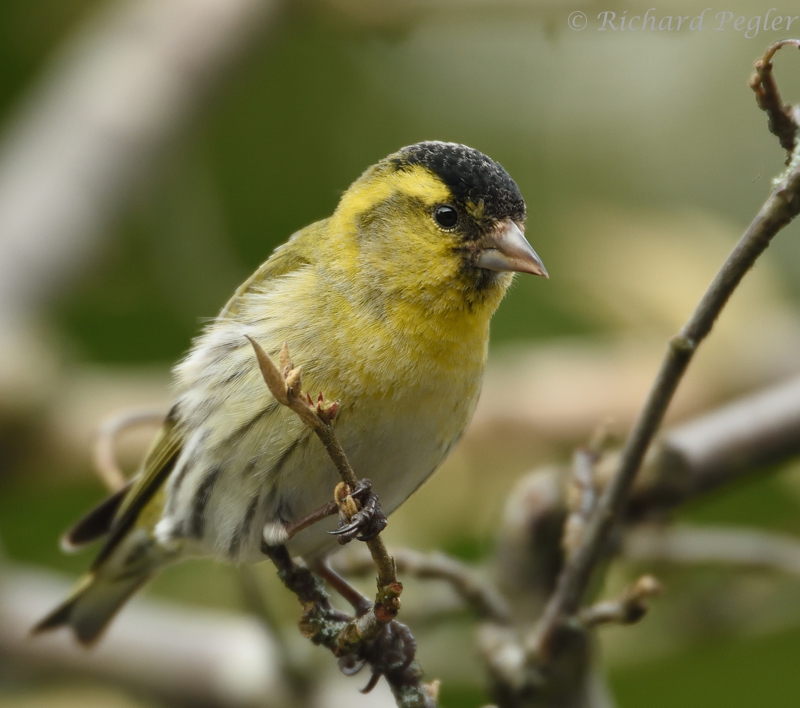
Siskin (Spinus spinus) (male) - Ashby de la Zouch on 18th April, 2019
If you would like to attract these birds to your garden, all three will come to sunflower hearts, and seem to prefer them in open trays rather than suspended tubular feeders. 

If you are feeding birds - and I hope you are - please remember to keep the feeders clean. Finches, in particular, are susceptible to a disease of the legs and feet which eventually destroys their feet, and this is thought to be transmitted through unhygienic feeders.
 

Thursday, 14 November 2019

NOVEMBER 14th MEETING RESCHEDULED TO 28th NOVEMBER DUE TO FLOODING

Following the cancellation at short notice of the meeting on November 14th our Chairman, Brian, has rescheduled the meeting to be on November 28th - details on the 'Meetings Programme' page.